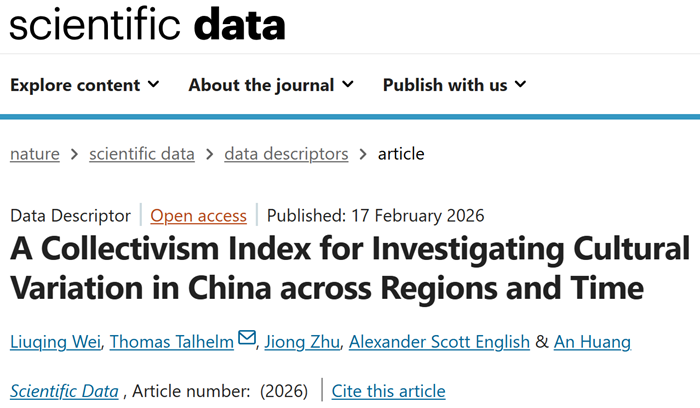
Recently, Dr. Wei Liuqing from the Department of Psychology at Hubei University collaborated with researchers from the University of Chicago, Peking University, and other institutions to publish a study titled “A Collectivism Index for Investigating Cultural Variation in China across Regions and Time” in Scientific Data, a journal under the Nature portfolio. The research has produced China’s first dataset of regional collectivism indices with both temporal continuity and geographic precision, offering a new quantitative tool for examining regional cultural differences and tracking cultural change in China. This work addresses a long-standing gap in the field by providing a standardized measurement for such studies.
Collectivism, one of the core dimensions in cultural studies, has long posed measurement challenges for researchers. Traditional self-report scales often yield results inconsistent with cultural common sense, while existing studies lack objective measurement tools with broad coverage, long time spans, and high geographic resolution. To address this challenge, the research team utilized large-scale objective data such as census records to construct a collectivism index at both provincial and prefecture levels. Eight indicators selected across dimensions including marital stability, household arrangements, innovative behavior, and public service provision. These indicators cover divorce-to-marriage ratio, proportion of people living alone, share of multi-generational households, and number of invention patents per capita.







 Contact Us
 Alumni
 Chinese
