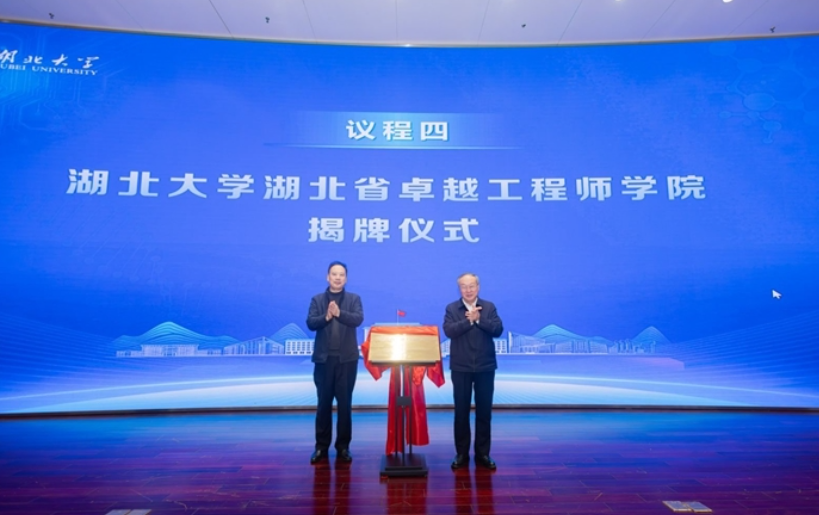
Hubei University officially inaugurated the Hubei Provincial College for Excellent Engineers on March 27 (hereinafter referred to as the “the College”).
The College aligns with the Accreditation Criteria for Excellent Engineers Education and adheres to the talent cultivation requirements set by Hubei Province. Guided by the philosophy of “small yet refined”, it concentrates onkey fields such as biomanufacturing and electronic information engineering. The College aims to cultivate high-caliber engineering professionals who are dedicated to the nation and their work. These individuals will possess a global perspective and outstanding technological innovation capabilities, be capable of addressing complex engineering challenges, and be prepared to undertake key tasks.
The College will establish a mechanism consisting of strategic decision-making by the Board, overall guidance by the Cultivation Steering Committee, and operational implementation by itself. The Board is chaired by the President of Hubei University, with leading enterprises in biomanufacturing and electronic information engineering serving as vice chairman units. Member institutions of the Board pool resources and make decisions on major matters. The Cultivation Steering Committee is composed of experts from both the university and enterprises, and is responsible for providing academic guidance on training programs, curriculum systems, and degree standards.
Zhu Xiaomei, Executive Dean of the Hubei Provincial College for Excellent Engineers, noted that biomanufacturing and electronic information engineering are strategic and foundational industries in China and are also key components of Hubei Province’s “51020” modern industrial clusters. Hubei University has solid academic accumulation in these fields and has established sound partnerships with enterprises. Taking these fields as the starting point, the College can effectively integrate traditional engineering strengths with emerging engineering education, thereby connecting the University’s broader engineering system.
“Adhering to the principle of being ‘small yet refined,’ we encourage deep participation by enterprises throughout the entire talent cultivation process. The inaugural cohort of students will be jointly selected from graduate students enrolling this year by university and enterprise mentors, via a two-way selection mechanism that facilitates substantive industry-education integration and science-education integration,” said Zhu. She further explained that the College will advance four key reform initiatives: strengthening the project pool and mentor pool, deepening joint enrollment and cultivation, reforming evaluation and degree conferral, and enhancing welfare and logistical support. Through these efforts, the College will deepen collaborative research with leading enterprises and enable talent cultivation and industry development to advance in tandem.







 Contact Us
 Alumni
 Chinese
