On January 4, the Hubei Science and Technology Innovation Conference was held. Hubei University won awards for eight scientific and technological achievements, including six awards as the first completing institution and two awards as a participating institution. Professor Cai Detian from the School of Life Science was awarded the First Prize of Technological Invention, marking the third first prize the University has received in the field of biology since the beginning of the 14th Five-Year Plan, and highlighting the remarkable achievements in the construction of biology as a first-class discipline at HUBU. Xie Hongxing, Secretary of the Party Committee of HUBU, and Professor Cai Detian attended the conference and received the award.
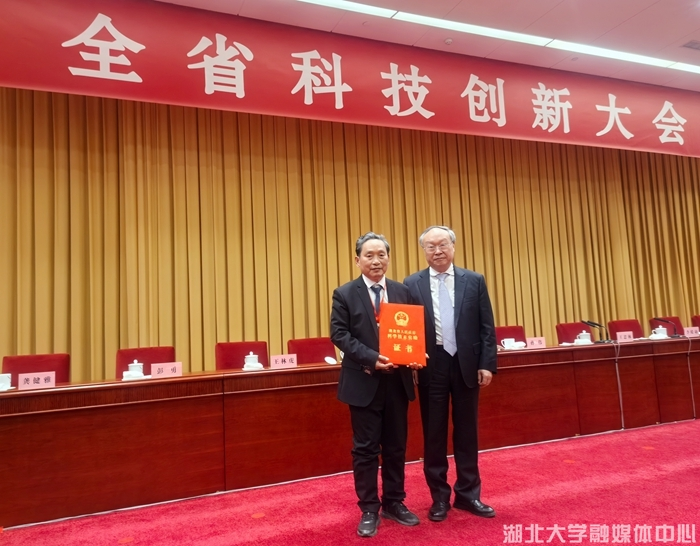
The project “Theory, Key Technologies and Germplasm Resource Innovation and Application of Polyploid Rice Breeding”, completed by Professor Cai Detian’s team, won the First Prize of Technological Invention, which is the highest-level award received by the University at this conference.Hubei University also achieved notable results in other disciplines. The teams led by Professor Zheng Dabin and Professor Wang Baoyuan won the Second Prize of Natural Science; the team led by Professor Song Huiting received the Second Prize of Technological Invention; and the teams led by Professor Wu Congcong and Professor Zhang Jiang won the Third Prize of Natural Science. In addition, Professor Zhang Xiuhua, as a member of a participating institution, won the First Prize of Natural Science, while Professor Wang Feiyi participated in a project awarded the Second Prize of Science and Technology Progress.
Focusing on the field of polyploid rice breeding, Professor Cai Detian’s team has conducted years of systematic research and successfully established the breeding theory of Breeding Super Rice by Utilizing the Dual Advantages of Distant Hybridization and Polyploidy. The team has also developed five major key technology systems, effectively overcoming core bottlenecks such as the low seed-setting rate of polyploid rice, a problem that has challenged the academic community for more than 70 years.The project successfully bred a series of superior lines and achieved the first-ever production application of polyploid rice. By opening up a new pathway for rice breeding, the project provides important theoretical and technological support for ensuring national food security and carries significant strategic importance.







 Contact Us
 Alumni
 Chinese
